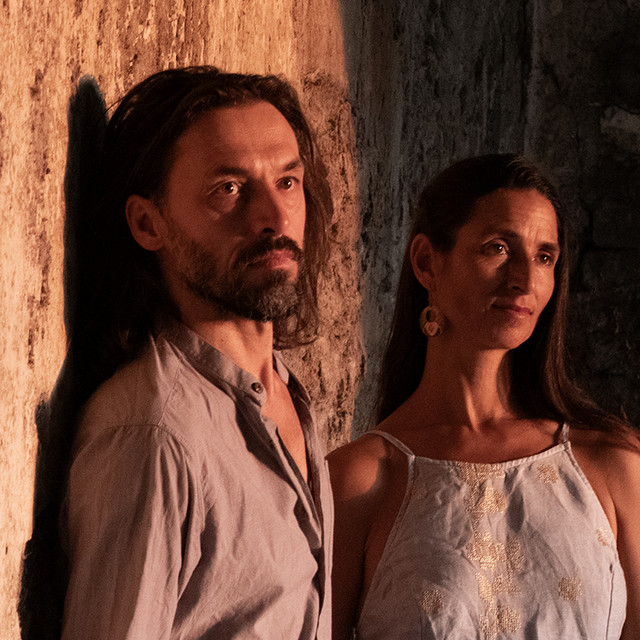
"Song of the Stars" is a reimagined kirtan from Mirabai Ceiba's 20th anniversary album Reimaginations, featuring vocalist Nessi Gomes and an ensemble that fuses acoustic instruments (harp, guitar, charango, cello) with synthesizers, B3 organ, and glockenspiel. Under producer Markus Sieber's direction, the track uses sonic contrast to explore inner wounds as gateways to understanding life's mystery and cosmic connection—with Nessi's raw, broken vocals embodying human grief and longing, while a choir's angelic voices point toward transcendence.
What Is "Song of the Stars" and Why Does It Matter?
"Song of the Stars" represents a deliberate artistic choice: taking a track that already held meaning within Mirabai Ceiba's catalog and reshaping it through contemporary sonic textures. The song is the fourth single from Reimaginations, a project marking the artist's two decades of work in sacred music. Rather than simply rerecording an old favorite, this version invites listeners into a fundamentally different emotional and spiritual landscape—one that acknowledges both the earthly dimension of human suffering and the transcendent realms beyond ordinary perception.
The collaboration with Nessi Gomes, whose voice carries what the production notes describe as "haunting and otherworldly" qualities, signals an intentional shift in sonic storytelling. This is not a simple acoustic remix. Instead, it's an architectural reimagining where acoustic and electronic elements sit side by side, creating tension and dialogue rather than conflict.
How Do Contrasting Instruments Tell a Spiritual Story?
The instrumentation of "Song of the Stars" operates on a principle of polarity and conversation. On one side sit traditional acoustic instruments—the harp, guitar, charango (a small South American stringed instrument), and cello—instruments with deep roots in devotional and world music traditions. On the other side emerge synthesizers, B3 organ, Prophet 05, and glockenspiel, the tools of electronic and contemporary production.
This isn't a case of one sonic world dominating the other. Instead, they create what producer Markus Sieber describes as a "lush bed"—a foundation where both textures remain audible and present. The harp's celestial shimmer coexists with warm synthesizer pads. The cello's earthy resonance sits alongside the Prophet 05's ethereal textures. This approach mirrors the song's thematic content: the material and the transcendent are not separate or opposed, but woven together.
The glockenspiel adds particular significance—its bright, bell-like tones have long been associated with angelic realms and higher consciousness in both orchestral and spiritual music traditions. By including it alongside instruments rooted in earth-based traditions, the arrangement suggests that access to the "spirit world" and "mysterious realms" mentioned in the description doesn't require us to abandon the body or material reality, but rather to perceive both simultaneously.
What Role Does Nessi Gomes' Voice Play?
Nessi Gomes' vocal performance is central to understanding how "Song of the Stars" works emotionally and spiritually. The production notes explicitly describe her voice as "delicate, broken yet powerful"—and this brokenness is not a flaw to be hidden but a feature to be highlighted. In spiritual and therapeutic contexts, brokenness often signals authenticity: the willingness to not perform perfection, but instead to offer raw human experience.
According to the production narrative, Gomes' voice becomes "the earth, the pain, the grief, the joy, and the search of a human." This is a specific artistic choice. Her vocals are not sitting above the arrangement as a decorative element, but as a container for emotional and existential material. When she sings, we are hearing human vulnerability in its fullest dimension—not transcended, not bypassed, but present and honored.
The description of her voice as an "opening doorway to the spirit world" suggests that this rawness itself is the portal. Spiritual traditions across cultures have long understood that grief, pain, and longing are not obstacles to transcendence but invitations into it. By refusing to polish or smooth Nessi's vocal texture, the production keeps this doorway open.
How Does the Choir Function as a Counterpoint?
The choir in "Song of the Stars" operates as a direct complement and contrast to Nessi Gomes' lead vocal. Described as "angelic" and "sweet," the choir represents what the producer calls "the gentle warm spirit of Angelika's voice, which travels to the stars." Where Nessi embodies earthly pain and human longing, the choir voices gesture toward transcendence, mystery, and the vast cosmos.
This is a deliberate compositional strategy. In classical and sacred music traditions, choirs have long symbolized unity, the collective, and the divine. By layering the choir's unified voices against Nessi's singular, broken vocal presence, the arrangement creates a dialogue between the individual human experience (with all its wounds and yearnings) and something larger—a realm where individual pain dissolves into collective transcendence.
The phrase "angelic sweet voices" carries particular weight in contemporary kirtan and devotional music contexts. Kirtan traditionally aims to invoke and invoke presence—to call forth divine qualities through sound. By designating the choir voices as "angelic," the production is suggesting that this musical layer is literally invoking celestial presence, drawing that energy into the song and into the listener.
What Is the Producer's Vision for Inner Wounds as Spiritual Portals?
Markus Sieber's role in shaping "Song of the Stars" centers on a particular spiritual insight: that inner wounds—rather than being problems to solve or emotions to transcend—are themselves portals. The production notes state that Sieber "guided the song on an expansive journey towards the inner wounds as a portal of connection with the mystery of life and the cosmos."
This vision reframes trauma, grief, and emotional pain in a specifically spiritual context. Rather than treating human suffering as an obstacle to enlightenment or transcendence, it positions suffering as an opening. When we fully meet our pain—when we don't bypass it or spiritualize it away—we touch something real about existence itself. That reality becomes a doorway into the "mystery of life and the cosmos."
This approach resonates with contemporary trauma-informed spirituality and with ancient wisdom traditions that understood breakdown as breakthrough. The sonic architecture of "Song of the Stars"—with its juxtaposition of raw human vocals against expansive orchestration—embodies this principle. The pain is not smoothed away; it's held within a larger container of beauty and cosmic vastness.
Why Does This Song Belong to an Album Called "Reimaginations"?
"Song of the Stars" is presented as part of a larger 20th anniversary project, which is significant. At two decades into a creative practice, an artist faces a choice: repeat what worked, or look backward with fresh eyes and contemporary tools. By calling the album Reimaginations rather than "Remasters" or "Classics Revisited," Mirabai Ceiba signals that this is not preservation work—it's reimagination. These are familiar songs encountering new production aesthetics, new collaborators, and new consciousness.
The inclusion of electronic elements, the collaboration with Nessi Gomes' distinctive vocal presence, and the therapeutic-spiritual framework Sieber brings all suggest that these "reimaginations" are not backward-looking. Instead, they're asking: what do these songs mean now? What happens when we bring contemporary tools, diverse voices, and newer understandings of trauma and spirituality to work we created years ago?
What Does Blending Organic and Electronic Sound Suggest Spiritually?
The deliberate fusion of acoustic and synthesized elements in "Song of the Stars" reflects a larger spiritual evolution in contemporary sacred music. There was a time when "spiritual" music was equated with "acoustic" or "natural" sound—the idea being that electronic processing was somehow inauthentic or removed from sacred truth. "Song of the Stars" decisively rejects this binary.
By treating synthesizers and organs as equally valid spiritual instruments as harps and cellos, the production suggests that technology itself is not spiritually neutral or negative—it's a tool for expression that can carry profound meaning. The B3 organ, with its warm, soulful character, has deep roots in soul, gospel, and spiritual music. The Prophet 05 synthesizer, a classic instrument of electronic music, becomes a vehicle for conveying otherworldliness and cosmic vastness.
This approach models something important: spiritual authenticity in the 21st century requires integration, not rejection, of technology. We don't transcend the contemporary world by abandoning its tools—we transcend by bringing consciousness and intention to how we use them.
Where to Go From Here
Listening to "Song of the Stars" invites several lines of deeper exploration. First, sit with the relationship between Nessi Gomes' raw vocal presence and the choir's angelic harmonies—notice how your nervous system responds to this dialogue between earthly and transcendent. Second, pay attention to the specific moment when synthesizers enter the soundscape: does this change your sense of what "sacred" or "spiritual" music can be? Third, consider the production philosophy that inner wounds are portals—how does this reframe your relationship to your own pain and grief?
You can explore more of Mirabai Ceiba's work at mirabaiceiba.com, and follow their ongoing creative journey through social media (@mirabaiceiba on Instagram and Facebook). The full album Reimaginations will likely continue this exploration of what happens when established kirtan and devotional music encounters contemporary production, diverse voices, and evolving spiritual consciousness.



